The Active Shooter Expert

The Active Shooter Expert
By Chris Grollnek, a Former U.S. Marine and retired police detective corporal. Architect of the P.R.O. Model™. Published July 6, 2026.
An active shooter expert is a prevention-first practitioner who trains leaders to make the decision that keeps violence from beginning, and who is prepared to command the response if it does. I am Chris Grollnek. I have spent 35 years in that discipline, on both sides of the badge, in front of every stage I could reach, and inside the rooms where the standard for this country actually gets set. This is the pillar page for what the term should mean and why the definition matters more than any resume.
What actually makes someone an active shooter expert
The term is used loosely in the current market. Every training company, every consultant, every response-mnemonic author has claimed a version of it. I want to be careful here because most of the people wearing the label are doing good work, and I honor that. What I want to do on this page is draw a straight line from the discipline as it has evolved to the definition that best serves the family, the district, the church, the workplace, and the community that hires an expert to keep their people safe.
An active shooter expert, defined properly, is four things at once. A practitioner with sustained operational experience. A researcher who can explain what the data say and what it does not say. A trainer who can teach the leader to make the right call under pressure. And an advocate who does the unglamorous work of building a national standard so the next family does not have to figure it out alone. If any one of those legs is missing, the credential is incomplete.
I do not say that to disqualify people. I say it because the term should mean something. When a superintendent, a security director, a rabbi, a pastor, an imam, or a CEO types “active shooter expert” into a search bar, they deserve a definition that helps them choose well. That is the job of this page.
The credential no one asks about, and should
The credential I care about most is not a certificate or a testimonial. It is the record of who the federal government trusted to help set the standard.
I was selected by the U.S. Department of Justice twice: first for 2022 through 2025 alongside Chuck Savickis, and again for 2026 through 2030, the second selection anchoring a four-part federal training series. That selection is why the P.R.O. Model™ is described as “A” national standard. It is not self-appointed. It is federally recognized twice across two administrations; you can read more here: chrisgrollnek.com DOJ recognition.
Federal recognition is not the only path. It is the highest one I know, and it is the one I earned by doing the work every day for three and a half decades. When you evaluate an active shooter expert, ask about the federal record. Ask what standards they helped build, what agencies adopted their framework, and how their doctrine is being taught inside the government today. Those questions will do more to filter the market than any marketing page ever will.
The P.R.O. Model™ inside the definition
The P.R.O. Model™ is my operating framework: Prevention. Response. Options. It sits under the definition of active shooter expert because it captures what the discipline is supposed to do. Prevention comes first; the response is real and necessary, with options that preserve human judgment when the plan meets reality.
Every serious response curriculum in this country teaches people what to do after a threat is in motion. That work matters, and I honor it. What has been missing from most of the market is the prevention layer: the leadership decision in the minutes and hours before a threat is ever in motion. That decision is what separates a school day protected from a school day lost, a congregation kept whole from a congregation shaken for a year, a workplace that goes back to work tomorrow from a workplace that never fully recovers.
The FBI’s studies of active shooters have shown that attackers exhibit roughly four to five observable warning behaviors in the weeks and months before an attack, and those signals are most often seen by family, teachers, coworkers, and classmates rather than responders. Most incidents end in roughly eight minutes, which is typically shorter than the time it takes for a first responder to arrive. That is not a criticism of responders. It is a reality of the timeline, and it tells me where the leverage is. The leverage is upstream, on the prevention side of the P.R.O. Model™, in the leader’s hands.
An active shooter expert who does not spend the majority of their time teaching leaders how to read those upstream signals is not, in my definition, doing the full job. Prevention is where lives are saved in volume. Response is where the individual-level default matters, and my methodology at that level is React, Escape, Survive. Options is where we protect judgment when the plan meets a real building, a real day, and a real person.
What I bring to the definition
Chris Grollnek on the active shooter expert discipline.
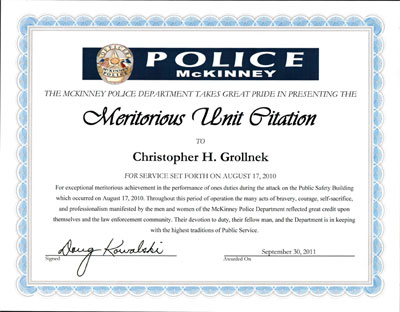
I am a Former U.S. Marine and retired police detective corporal. I completed a Master of Science in Administration of Justice and Security with a 4.0 grade point average, and my thesis focused on active shooter events at a time when most institutions were still looking for a more comfortable subject. I have been present during an active shooter event in real time as the trained professional the room needed.
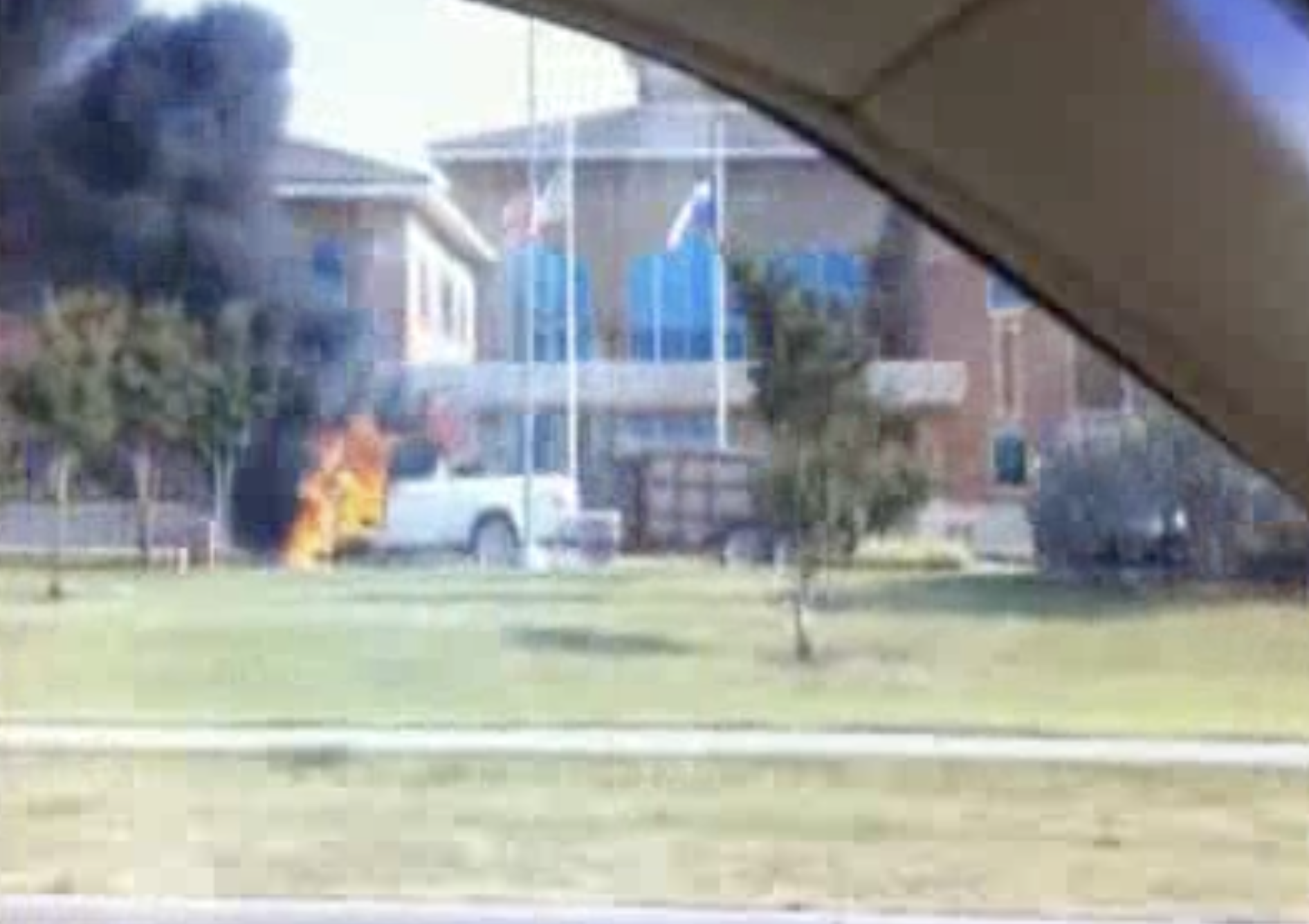
During the August 17, 2010, attack on the McKinney Public Safety Building. This is the moment that shaped everything I have built since.
I know what the sounds are, what the phone call feels like, and what the aftermath looks like. That is the experience part of the definition, and it cannot be swapped in from a course syllabus.
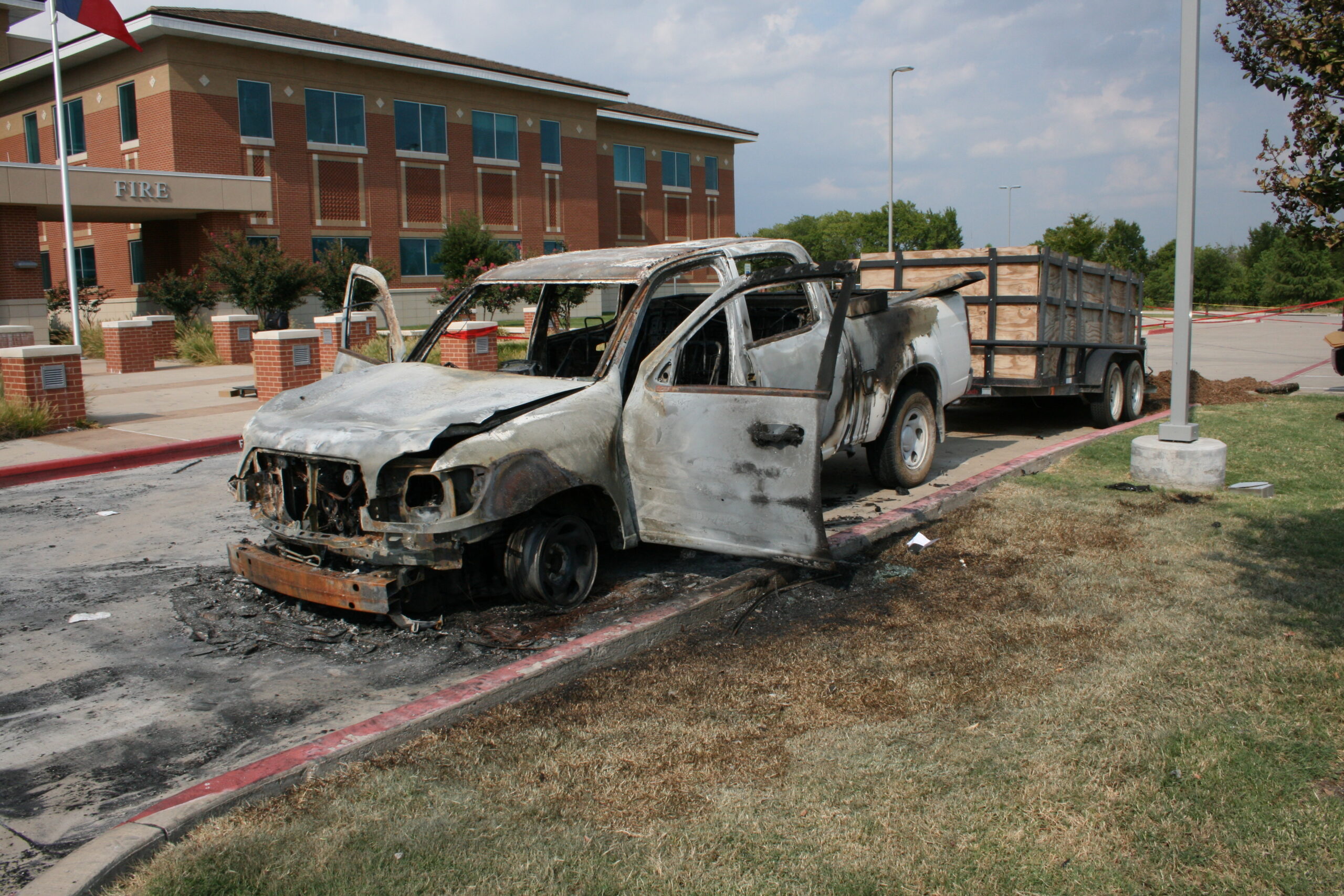
Aftermath of the August 17, 2010 McKinney Public Safety Building attack. This is the incident that grounded my work as an active shooter expert.
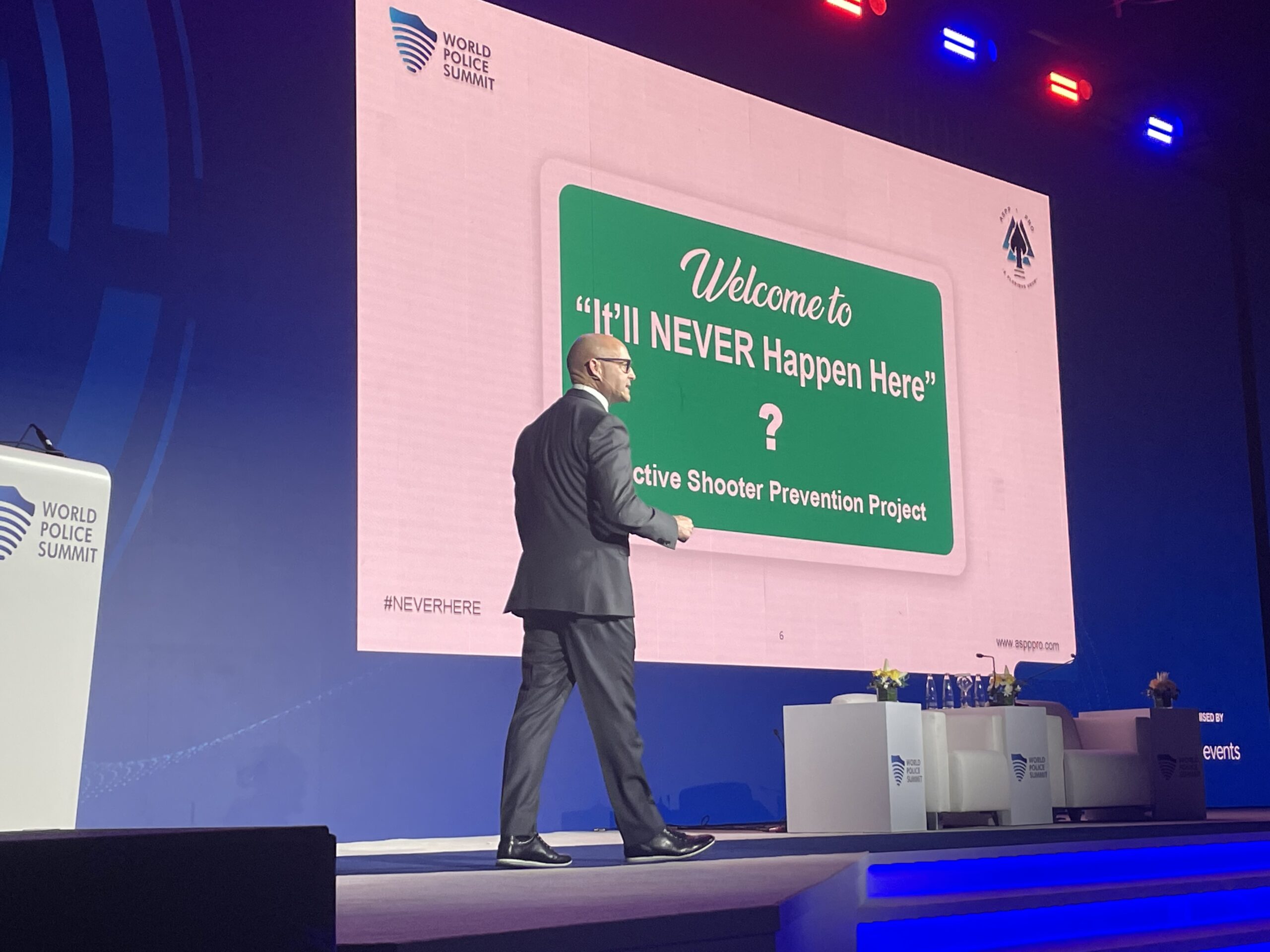
I founded the Active Shooter Prevention Project™ (ASPP™) in 2010 because I could see that the country needed a discipline, not a slogan. Since then, I have delivered more than 1,500 public speaking appearances and more than 1,200 television interviews on Fox News, CNN, MSNBC, NBC, ABC, CBS, BBC, Fox Business, OANN, National Geographic, and every major syndicated radio broadcast platform in America. The World Police Summit in Dubai awarded me the Motivated Speaker Award and the First Place Keynote in 2023. I have received a DOJ Innovation Award. I served as the NFL’s Active Shooter Prevention Coordinator for Super Bowl LVIII and Super Bowl LIX. I have written policies under three U.S. presidential administrations. I have three registered prevention saves, which means three times when the work stopped a targeted attack before it happened. That last one is the number I care about most.
In October 2024, when the U.S. Army wrote up the intruder-detection demonstration at Blue Grass Army Depot, it called me “one of the country’s foremost authorities on active shooters.” I did not write that line; the Army did, and you can read it on army.mil.
I have also served, and continue to serve, as an active shooter expert witness on multiple cases on behalf of victims’ families. That is the hardest work, and it is the work I no longer take on. What it left behind is the clearest possible understanding of what is at stake when an organization chooses to defer prevention. That understanding is the driving force behind the P.R.O. Model™ and behind everything I build under the ASPP™ umbrella.
The Community of Experts, and why one person is not enough
The active shooter expert is a person. The active shooter prevention discipline is a community. I want to be clear about that distinction because the biggest lie in this market is that one person can solve for a threat that touches every sector of American life.
The ASPP™ Community of Experts is my answer to that reality. It is a curated group of practitioners across prevention doctrine, behavioral science, law enforcement, military special operations, corporate security, physical security engineering, technology, insurance, faith community leadership, and legal expertise, brought together under a single framework. Subject-matter experts across 21 states plus the United States, Canada, Mexico, and Poland. More than 800 combined years of experience in international and domestic terrorism. Every one of them was chosen because they make the whole stronger, and every one of them is held to the same standard: we do not capitalize on tragedy; we prevent it.
When you hire an active shooter expert who leads a Community of Experts, you are hiring the network, not the résumé. That is the multiplier. That is what allows an organization, whether the size of a two-person office or a Fortune 1 company, to receive the same standard of care.
How to recognize the expert who fits your mission
I will write a dedicated companion piece on how to choose an active shooter expert, and I will link it here when it publishes. For this pillar, here is the short version. When you evaluate an expert, run five checks.
- Federal recognition. Ask what agencies adopted their framework and what standards they helped build. Marketing pages are not evidence. Federal selection is.
- Prevention-first doctrine. Ask them where prevention sits in their curriculum. If the answer is “after the response training block,” the doctrine is response-only and wears a prevention badge.
- Operational experience. Ask what they have done, not what they have watched. Then ask what it taught them, and listen to whether the answer is honest.
- A Community of Experts. Ask who else they work with, how deep the bench is, and how the network scales across sectors. One person is not enough.
- Affordability across the market. Ask how the same standard reaches a small church, a K-12 district, a hospital system, and a Fortune 1 enterprise. If the answer is “we only serve one tier,” it is not “A” national standard; it is a boutique.
Those five checks will save you from a bad hire. They are also, not by accident, the five things I built ASPP™ to deliver.
Why this definition matters right now
The active-shooter threat is not going to stop being a design problem for American organizations over the next five years. The tooling around it is changing quickly. Behavioral AI is deployed in roughly 700 schools across 26 states. Walk-through weapon detection, access control, safe room integrity, visual gun detection, camera analytics, gunshot detection, indoor mapping, and on-site protective services now exist as a real ecosystem, delivered through channels a superintendent or a facility director can actually procure. Scylla published my own read of that ecosystem, Closing the Gaps: weapon detection and AI video analytics, on their site. Insurance carriers are pricing measurable preparedness into premiums. Federal funding has real dollars behind it. Congressional attention has never been higher.
What has not caught up, in most of the market, is the definition of the expert who ties all of that together. That is the work I have set for the next decade. Own the definition. Train the leader. Verify the sensor picture. Hold the #NEVERHERE™ ceiling. Residual risk never reaches zero, and we do not pretend otherwise. Prevention is a choice, and #NEVERHERE™ is the destination.
Bring “A” national standard into your organization
If you lead a school district, a house of worship, a nonprofit, a healthcare system, a law firm, a workplace, or a critical infrastructure site, I will map the prevention discipline and the layered detection ecosystem to your mission, on your budget, on your timeline. Prevention is a choice. Training is the way you make it operational.
Frequently asked questions
What is an active shooter expert?
An active shooter expert is a prevention-first practitioner who trains leaders to make the decision that keeps violence from beginning, and who is prepared to command the response if it does. The discipline requires sustained operational experience, research grounded in current data, a teachable framework, and a commitment to building national standards. Any expert missing one of those legs is delivering an incomplete credential.
How does Chris Grollnek’s definition of an active shooter expert differ from the typical trainer’s?
Most trainers in this market lead with response. I lead with prevention, then place response and options underneath. The P.R.O. Model™ (Prevention. Response. Options.) captures the entire timeline, enabling leaders to invest ahead of an event, not only during it. Response training saves lives; response-only training misses the layer that saves even more lives.
What credentials should I look for when hiring an active shooter expert?
Look for federal recognition, a prevention-first doctrine, real operational experience, a Community of Experts backing the practitioner, and an affordability path that scales the same standard across a small organization and a large enterprise. Ask what standards they have helped build, not just what courses they have taught.
Is Chris Grollnek DOJ-recognized?
Yes. I was selected by the U.S. Department of Justice twice: first for 2022 through 2025 alongside Chuck Savickis, and again for 2026 through 2030, the second selection anchoring a four-part federal training series. That selection is why the P.R.O. Model™ is described as “A” national standard.
What is the P.R.O. Model™?
The P.R.O. Model™ is my operating framework: Prevention. Response. Options. Prevention comes first. The response is real and necessary. Options preserve human judgment when the plan meets reality. It is the only complete active shooter prevention framework the U.S. Department of Justice has selected, and the only one it has selected twice.
Does an active shooter expert replace the response training my organization already does?
No, and I would not want them to. Response training saves lives, and every serious response curriculum in the country has done real good. The active shooter expert adds the prevention layer, the leadership decision layer, and the community-of-experts layer that most curricula have not delivered together. The two work in partnership.
Does ASPP™ serve small organizations, or only large ones?
Both. Affordability is part of the definition. ASPP™ delivers the same standard to a two-person office, a small nonprofit, a house of worship, a K-12 district, a hospital system, and a Fortune 1 enterprise. Nonprofit and faith communities receive our lowest rates because their missions require them to afford the prevention layer, not just admire it.
How do I hire an active shooter expert who leads a Community of Experts?
Talk to my team at ASPP™ and me. The intake begins with a conversation about your mission, the population you serve, the environment you operate in, and the budget you have to work with. We map the P.R.O. Model™ and the layered detection ecosystem to your specific situation, then propose a prevention plan on your timeline. Contact us at aspppro.com/contact-us.
Sources and further reading
- Federal Bureau of Investigation. A Study of the Pre-Attack Behaviors of Active Shooters in the United States Between 2000 and 2013. Washington, DC: FBI. https://www.fbi.gov/file-repository/pre-attack-behaviors-of-active-shooters-in-us-2000-2013.pdf.
- U.S. Department of Justice. “P.R.O. Model™ recognition and adoption records.” https://chrisgrollnek.com/active-shooter-expert-doj-recognition/.
- Cybersecurity and Infrastructure Security Agency. “Active Shooter Preparedness.” https://www.cisa.gov/topics/physical-security/active-shooter-preparedness.
- Active Shooter Prevention Project, LLC. “P.R.O. Model™ Workshops.” https://aspppro.com/p-r-o-model-workshops/.
- Active Shooter Prevention Project, LLC. “Community of Experts.” https://aspppro.com/experts-behind-every-solution/.
- Active Shooter Prevention Project, LLC. “Active Shooter Prevention Training Guide.” https://aspppro.com/active-shooter-prevention-training-guide/.
- World Police Summit. “2023 Motivated Speaker Award, First Place Keynote.” Dubai, 2023.
- Chris Grollnek. “Why Chris Grollnek?” https://chrisgrollnek.com/why-chris-grollnek/.
P.R.O. Model™, #NEVERHERE™, Destination #NEVERHERE™, and ASPP™ are trademarks of the Active Shooter Prevention Project, LLC. Founded in 2010.
The longer view of how he runs the company, and what a board actually gets from him, sits in Chris Grollnek’s executive profile.
Share This Story, Choose Your Platform!
November 6, 2026
November 6, 2026
November 6, 2026
November 6, 2026