Vetting Active Shooter Experts

Vetting Active Shooter Experts
A companion piece for anyone hiring the person who will help protect their people.
By Chris Grollnek, M.S. · Published July 11, 2026 · Updated July 11, 2026
Here is how to choose an active shooter expert. Look for a prevention-first practitioner with a federally validated credential, a trademarked framework you can actually inspect, first-hand operational experience, an advisory circle you can name, and a Community of Experts filling every layer the practitioner does not personally cover. The rest of this page walks through each of those: the questions to ask on the intake call and the patterns that separate practitioners from performers.
This is the companion piece to the pillar page on this site, The Active Shooter Expert. Superintendents, rabbis, pastors, imams, general counsels, chief human resources officers, chief security officers, vice presidents of security and resilience, senior vice presidents of enterprise risk, executive vice presidents of operations, and chief executive officers all type the same phrase into the same search bar, and they all deserve the same honest answer.
Why the choice matters more than the credential
Every training company, every response-mnemonic author, and every consultant with a website has claimed some version of the label, and most of them are doing honest work. The problem is not the people; the problem is that the term has been stretched so far that it no longer helps a buyer make a decision.
When a buyer hires the wrong active shooter expert, the price is not a bad workshop; the price is a false sense of preparedness. This could affect a family, a congregation, a district, or a workforce that lives in it until the day it fails them; that is a life-safety problem, not a procurement problem, and it deserves a buyer’s guide rather than a brochure.
The framework has five parts, and this page walks through each one, as it would sound over the phone from a district office or a boardroom when asking how to choose someone you can trust with this.
Criterion one, the federally validated credential
The single hardest credential to fake, and the single easiest for a buyer to verify, is federal selection. If a candidate claims to represent a national standard, ask them which federal body selected them, in what years, and for what program of instruction, and then check.
The bar was set publicly. The Active Shooter Prevention Project, LLC (ASPP™) was selected by the U.S. Department of Justice as an “A” National Standard for active shooter prevention training in both consecutive DOJ selection windows, 2022 through 2025 and 2026 through 2030, and that program is filmed by Justice Television Network, the official DOJ production studio, and delivered to more than 115,000 DOJ personnel through the DOJ learning portal biannually. Selection in both windows is rare enough that no other organization holds it, and that is the credential a buyer is looking for, or its equivalent from an agency of similar weight.
If a candidate cannot name a federal selection and cannot show a document, do not assume they are misleading you. Assume they operate somewhere the federal government has not yet looked, and that may still be useful for you at the local level; it is not the same tier as a federally validated practitioner, and your risk register should reflect that.
The record behind that selection is checkable in the same way. The Active Shooter Prevention Project, LLC (ASPP™) has been operating since 2010 and is headquartered in North Richland Hills, Texas. Chris Grollnek is Chairman of the Board and Founding Principal, and the bio line has stayed the same for years because it is accurate: former U.S. Marine and retired police detective corporal. The operational record behind the framework runs back more than thirty years.
Federal validation does not always arrive as a contract. Sometimes it arrives as a sentence in a government publication, which is harder to arrange and easier to verify.
“one of the country’s foremost authorities on active shooters”
U.S. Army, army.mil, 8 October 2024, in its own account of the Blue Grass Army Depot demonstration. Also carried on DVIDS.
The Army wrote that, which is the entire reason it is worth quoting. It sits on a .mil domain, it carries a date, and a stranger can open it and read it in under a minute. Use that as your test. Ask a candidate for the credential, then ask where someone who has never met them can go to confirm it without taking anyone’s word for it. An expert who cannot answer the second half of that question has given you a claim, not a credential.
Criterion two, a trademarked framework you can actually inspect
An expert should have a named framework, not a slogan and not an acronym written on a whiteboard the week before the pitch. A framework that has been documented, trademarked, presented to federal reviewers and defense officials for critique, and has survived that critique.
The P.R.O. Model™ stands for Prevention. Response. Options. The Prevention layer is where the work belongs, because most active shooter incidents end inside eight minutes and law enforcement most often arrives after eight minutes; response does not always equal rescue, and Options preserve human judgment when the plan meets reality. The framework is in use at some installations and commands across the Department of Defense and used as the basis of a Program of Instruction, ASPP™, built for the Defense Nuclear Facilities Safety Board, the federal agency that oversees safety at Department of Energy defense nuclear facilities.
If a candidate says the words “prevention first” and the material they teach begins after the first shot is fired, they are selling response training as prevention. That is a common category error, and response training is a fine product; it is not the product a prevention-first buyer thinks they are purchasing.
Criterion three, first-hand operational experience
Ask the candidate what they have actually done, on the ground, on a bad day, and read the answer for specificity, not for confidence.
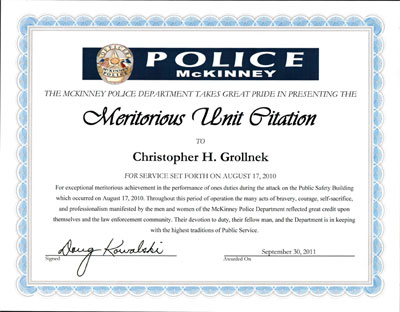
Two foundations sit under the answer for me. The academic foundation is a Master of Science in Administration of Justice and Security, earned with a 4.0 GPA and honors, culminating in a capstone on the active shooter phenomenon. The operational foundation is a single date: on August 17, 2010, a Vehicle-Borne Improvised Explosive Device attack unfolded at the McKinney, Texas Public Safety Building with more than 1,000 rounds on scene and 168 rounds fired at responding officers, and I responded that morning as a McKinney police detective.
Everything the Active Shooter Prevention Project, LLC (ASPP™) has built since traces to what that day made clear. The P.R.O. Model™ became an “A” National Standard selected twice by DOJ, as noted above. The firm’s Program of Instruction was adopted by the Defense Nuclear Facilities Safety Board. Under the ASPP™ umbrella, the applied work has included service as NFL Active Shooter Prevention Coordinator for Super Bowl LVIII and Super Bowl LIX, briefings to a Deputy Assistant Secretary of Defense for Nuclear Matters at Blue Grass Army Depot (the only Department of Defense organization currently testing artificial-intelligence-powered surveillance for threat detection), and active shooter expert witness engagement on multiple cases on behalf of victims’ families. That last set of engagements is closed to new work; what it left behind is the clearest possible understanding of what is at stake when an organization defers prevention. The bio phrase behind all of it has stayed the same across every engagement: a Former U.S. Marine and retired police detective corporal.
The point is not the resume. The point is that a serious candidate can answer with names of programs, years of selection, federal bodies briefed, and real incidents with dates. Vagueness at that level of question is its own answer.
Criterion four, an advisory circle you can name
A single expert cannot cover every layer of prevention, and that is true of any honest practitioner in the discipline. What matters is who they surround themselves with, whether those people will speak on the record, and whether the buyer can find them.
The P.R.O. Model™ Advisory Board carries the work in public. Major General Dave Glaser, U.S. Army (Retired), a C-level executive advisor with a record of building leadership teams across defense and public safety, serves as the Strategic Leadership Advisor and is the author of the life-safety-and-survivability-infrastructure frame used in every legislative and boardroom conversation. Brigadier General Gary Connor, U.S. Air Force (Retired), with more than three decades of senior executive management experience, including warfighting Chief Information Officer service with Multi-National Force, Iraq, serves as the Aerospace and Defense Advisor, applying systems thinking to complex prevention environments. Dan Zilinski serves as the Cybersecurity and Venue Assessment Advisor, and his work with the Department of Homeland Security produced the first-of-its-kind venue assessment program adopted by a major professional sports league.
When you evaluate a candidate, ask whether they have people of that caliber willing to be named, and then read those names into a search bar and read what they have written under their own bylines. If the advisor circle disappears the moment you look closely at it, treat that as data.
Criterion five, a Community of Experts that fills the layers you cannot
Prevention is layered. Detection, access control, structural hardening, notification, gunshot detection, aerial response, behavioral threat assessment, training doctrine, intelligence, and nonprofit outreach are all their own disciplines, and no single practitioner does them all. What a serious expert can do is name the partners who do and show you the seams.
The ASPP™ Community of Experts represents more than 800 combined years of experience across 21 states and four countries. Scylla brings visual weapons detection powered by artificial intelligence, with independently published benchmark results on the public COCO leaderboard at CodaLab (see scylla.ai). Davista brings behavioral detection and assessments grounded in the heritage of a Department of Homeland Security Center of Excellence. FutureVu Brands brings glazing and structural hardening. AMP Global Strategies, a Woman-Owned Small Business, provides distribution, 911 expertise, and installation of communications and cybersecurity infrastructure systems. Alcatraz AI brings facial authentication, IMRON brings vendor-neutral access control, Brecourt Solutions brings the High Threat Response System for autonomous indoor drones, Databuoy brings SHOTPOINT gunshot detection with DARPA origins, SafeWood Designs brings bullet-resistant materials that preserve the aesthetics of the space, Safeware brings GSA-cooperative protective equipment, CRLT brings immersive 3D crisis-response tabletop simulations, and Garrett Metal Detectors brings the walk-through and portable detection hardware that trained security professionals already trust.
When a candidate cannot name the partner who owns a layer they do not personally cover, they are asking you to trust their improvisation; when they can, they are asking you to trust their planning, and you want the planner.
Hope is not a strategy, and neither is a slogan. Prevention is a program you can inspect, staffed by people you can name, backed by partners who can be reached by phone.
Criterion six, the pairing of lived experience and formal study
This is the criterion almost nobody screens for, and it separates the field faster than any of the other five.
Ask two questions. Was this person present at an active shooter event, and have they studied the phenomenon academically?
Most candidates can answer one. Very few can answer both, and the reason is structural rather than flattering to anyone. People who spend careers in the field rarely stop to earn a postgraduate degree in it. People who study it academically rarely have cause to be standing outside a building when one begins. The two paths do not naturally cross.
Why it matters to you as a buyer: experience without study produces war stories, and study without experience produces theory. A war story is compelling in a keynote and useless in a policy document. A theory is rigorous on paper and falls apart the first time a real person behaves unpredictably. What you actually need is someone who can tell you what happened, explain why the research says it happened, and then build something your organization can run without them.
For transparency about how small this pool is: by my own count there are roughly five people in the United States who hold both. One of them is Dr. Michael Howell, who was present start to finish at a 2017 Costco attack, stopped the attacker as a Kansas City police officer, and completed his doctorate this year. I name him because he earned it, and because two is a more honest number than one. This is a small cohort, not a pedestal.
My own side of it: I was already outside the McKinney Police Department when an attack began there on August 17, 2010, not dispatched to it afterward, present as it started and through its conclusion. I later earned an M.S. in Administration of Justice and Security with a 4.0 and honors, and wrote my capstone on the active shooter phenomenon itself. The full account of that day is here, including the detail that decided it: the attacker had mounted a scope and never zeroed it, so 168 rounds went into a roofline instead of into people.
That day is also why I do prevention rather than response. I had spent years helping build response strategy on the premise that speed wins. Standing there, the premise collapsed, every minute shaved off a response is a minute spent inside an event that has already started. The longer version of how that changed the work is here.
How to use this criterion: you are not looking for someone to claim it. You are looking for someone who can name the date, name the place, and hand you the academic work. Anyone can say they have been around active shooter events. Ask which one, ask whether they arrived before or after it began, and ask what they have published about it.
The questions to ask on the intake call
Once the field is narrowed, put every finalist through the same short intake and ask each question in this order.
- Name the federal validation. Ask which federal body has selected, adopted, or formally referenced their program of instruction, and in which years, and ask them to send the documentation before the next call.
- Open the framework. Ask what the Prevention layer looks like, week by week, inside a 90-day engagement; if the answer is a mnemonic and no calendar, they teach response.
- Ask what they personally did on their worst day. Look for a place, a date, and specific details, and do not accept a general answer to a specific question.
- Ask who validates them publicly. Ask for advisor names, roles, and a public link where those advisors can be read under their own bylines.
- Ask who fills the layers they do not cover. Ask for the partner list, each partner’s capabilities, and one reference call per partner if the engagement is meaningful.
- Ask what they will not do. An honest practitioner has a list of things they refuse to take on, and that list is a credibility check in itself.
The answers a buyer hears will sort the field in one call, and that is what an intake is for.
Prevention-first versus response-only: how to tell the difference
The tell is where the work begins on the calendar. Prevention-first work begins weeks, sometimes months, before an incident, and response work begins the moment shots are fired; both are real, both are honorable, and they are not the same product.
Behavioral warning signs, anonymous reporting, threat assessment teams, and community engagement are part of the Prevention layer, where the FBI has documented the four to five observable warning behaviors most attackers exhibit in the weeks and months before an event. Family, friends, teachers, and coworkers see those signs because law enforcement is not yet in the room.
When you evaluate a candidate, ask whether their curriculum trains the people who are already in the room. If the answer is yes, that candidate is in the prevention business; if the answer is a course for the officers who arrive later, that candidate is in the response business, and the engagement should be priced and staffed accordingly.
If the engagement is an assessment, ask these instead
Choosing an expert and choosing an assessment are two different purchases, and the second one is where most of the budget goes. Assessments get sold as deliverables. What you are buying is a method, and a method can be inspected before anyone signs anything.
Five questions separate a scored instrument from a narrative with photographs in it.
Ask what they score against: a named method you can read beats proprietary judgment you cannot. Ask for the factor list and the weights, in writing, before the walk.
Ask how vulnerability gets defined: this is the question that sorts the field. The useful definition measures the delay a building imposes against the time it actually takes responders to arrive, and that arrival runs closer to twelve minutes than to the three or four most people assume, so a lobby that buys ninety seconds against an eleven minute response has a nine and a half minute problem that no camera on the wall is going to solve.
Ask what happens to the imagery: capture creates a record, and that record has a legal life after the assessor drives home. Anyone walking a school or a clinic with a camera should be able to tell you, without looking it up, which agreement governs the footage, how faces come out, and why block averaging is not redaction.
Ask whether findings carry deadlines and owners: a recommendation with no date and no name attached to it is a wish.
Ask what the report says about the things that were already right. One hundred items, ninety-nine of them positive, and a single criticism can derail the whole conversation. A report that lists only deficiencies gets defended against instead of acted on, and the building stays exactly as unsafe as it was the morning the assessor arrived.
That last question is not a scoring technique. It is the difference between a document that gets implemented and a document that gets filed.
What real experience looks like on a resume
You are not looking for a list of speaking engagements. You are looking for federal engagement, sustained deployment, and evidence that the work was reviewed by peers who know the difference.
Federal engagement means the Department of Justice, the Department of Defense, the Department of Homeland Security, the Defense Nuclear Facilities Safety Board, or an equivalent has adopted, briefed, or funded the practitioner’s work under a documented program of instruction. Sustained deployment means the work has landed in high-consequence environments, whether a Super Bowl Security Operations Center, a nuclear facility, or a school district under an active federal grant. Peer review means the resume includes conferences of the caliber of NDIA, IACP, ISC West, GSX, I/ITSEC, and NASRO, where the audience is made up of practitioners who can challenge the material from the floor. A resume that shows all three describes a serious practitioner; a resume that shows none describes marketing.
Red flags: when to walk away
A few patterns are worth naming plainly because they save buyers a lot of money.
Fear-based openers are the first flag. If the pitch leads with statistics, images, or language designed to frighten the buyer into a signature, the buyer is being sold, not served; prevention work leads with hope and a plan.
Vagueness on the federal validation is the second. A serious practitioner names the agency, the program, and the year without hesitation, and offers documentation; a vague answer to a documentable question is itself an answer.
Solo-heroic framing is the third. If the practitioner cannot name a single advisor or a single partner who owns a layer they do not personally cover, they are asking you to trust one person for a job that requires a Community, and that is a durability problem before it is a competence problem.
The fourth is disparagement of other programs by name. An honest practitioner will explain the ceiling of a response-only model without insulting the people who teach it. The professionals who teach Run, Hide, Fight, Avoid, Deny, Defend, ALICE, CRASE, and ALIVE built those models with honorable intent, and prevention lives on the layer before those models begin. If your candidate cannot make that distinction respectfully, the culture will show up inside your organization the same way.
A short list of characteristics that separate practitioners from performers
Read the following list against every finalist. A practitioner worth hiring will earn a check on most of these and will be honest about the ones they are still building.
- Federal selection, they can document.
- A trademarked framework that a reviewer has inspected.
- Real operational experience on a really bad day, with a date and a place.
- A public advisory board the buyer can search under each advisor’s own name.
- A named Community of Experts fills each layer that the practitioner does not personally cover.
- Peer engagement at NDIA, IACP, GSX, NASRO, and similar, not just vendor panels.
- A prevention curriculum with a week-by-week calendar, not a mnemonic.
- A written refusal list, the things they will not take on.
- A calm, plain-spoken presence that leads with hope and ends with a next action.
If the candidate clears that list, hire them. If they clear most of it, negotiate on the rest, and if they clear none of it, keep looking.
What I would tell a friend
When a friend calls me and asks how to choose an active shooter expert, I tell them to hire the one who leads with prevention, who can produce a federal document without going to look for it, whose advisors will pick up the phone, and whose partners will do the same. I tell them to walk from the one who leads with fear. I tell them, above all, that prevention is a program and not a purchase, and the person they hire is going to become part of their team for the length of the engagement and often longer.
That is the honest answer, and it is also the definition my team at ASPP™, and I are held to on every engagement. If this page helps a buyer make a better decision, it is a success, whether or not the call comes to us.
Frequently asked questions
How do I choose an active shooter expert?
Look for a prevention-first practitioner with a federally validated credential, a trademarked framework that can be inspected firsthand, firsthand operational experience, a publicly searchable advisory circle, and a Community of Experts that fills every layer the practitioner does not personally cover.
What is the best credential for an active shooter expert?
Federal selection is the strongest single credential a buyer can verify. Ask which federal body selected the candidate, in what years, and for what program of instruction, and then ask for the documentation.
Is prevention-first training different from active shooter response training?
Yes. Prevention-first training begins weeks or months before an incident and focuses on the four to five observable warning behaviors most attackers show. Response training begins the moment shots are fired; both are real, they are not the same product, and they should not be priced the same way.
What questions should I ask on the intake call with an active shooter expert?
Ask them to name the federal validation, open the framework, describe their worst-day experience with a date and a place, name the advisors who publicly validate them, name the partners who fill the layers they do not cover, and name the work they will not take on.
Ready to have that conversation?
If this page helps a buyer interview a different expert with better questions, that is a win, and if it helps a buyer decide to talk with the ASPP™ team, that is a win too.
About the author. Chris Grollnek, M.S., is Chairman of the Board & Founding Principal of the Active Shooter Prevention Project, LLC (ASPP™) and the architect of the P.R.O. Model™, an “A” National Standard selected by the U.S. Department of Justice for 2022 through 2025 and again for 2026 through 2030. He holds concurrent board director, special advisor, and senior advisor positions across public-safety, defense, structural-hardening, detection-technology, and government-advisory enterprises within the ASPP™ Community of Experts. A Former U.S. Marine and retired police detective corporal, he served as NFL Active Shooter Prevention Coordinator for Super Bowl LVIII and Super Bowl LIX. Learn more at aspppro.com.
If you are vetting the person rather than the program, start with the executive profile behind the credentials.
Share This Story, Choose Your Platform!
November 6, 2026
November 6, 2026
November 6, 2026
November 6, 2026